As a business owner, you know your legal obligations. You file an income tax return once a year. Your tax returns are filed as required (monthly, quarterly or annually). You also pay government remittances, comply with labor standards, and so on.
Financial information for business owners
Among these is the tax return, which coincides with the end of the fiscal year, and gives you the opportunity to review your financial statements. These are produced by your Chartered Professional Accountants (CPAs), whether as part of a compilation, review or audit engagement.
It’s an opportunity for you to measure your sales growth, make sure your profit margins are stable, calculate the weight of your fixed sales and administration costs… In short, you can confirm whether your business is profitable!
Of course, for most entrepreneurs, this information comes as no surprise, since they carefully monitor their company’s financial results throughout the year using internal financial statements. For others, who see the variation in their profit margin once a year, it’s important to review the way financial information is tracked.
Discover the benefits of tracking financial information with internal financial statements, and the possibilities offered by the dashboard.
The “bank account” method
Too often I’ve heard business leaders say that if the bank account is full, then everything’s fine. However, the “bank account” method is not only inadequate, it’s even dangerous!
You could be at a loss for a long time before realizing that your profit margin has shrunk. By then, it would be too late, and any corrective measures you took would take longer to take effect. The measures might have to be more drastic. Your working capital would deteriorate, and you might have to re-inject additional cash to continue operations.
Internal financial statements
Conversely, a strong accounting department means you get your financial statements every month. Thanks to the information contained in them, you’ll be able to see, for example, the slightest variation in gross margin and explain it. If corrective measures need to be put in place, you’ll be able to implement them very quickly, so you won’t have to watch your gross profit erode for months before you even notice it.
It’s true that you can get financial statements every month, but if the information they contain is no good, then they’re useless, or worse, they could mislead you. You need to be sure of the quality of the information they contain.
Obtaining quality financial information quickly requires effort and investment, starting with an accounting system tailored to your business and properly trained employees, including a controller. It’s not necessary for your controller to have a CPA designation, but experience in the tasks required of him or her will greatly contribute to efficiency. You may also choose to outsource your bookkeeping to a specialized firm; this requires the cooperation of the company’s management, who must then provide the necessary documents and answers within a reasonable timeframe. The basis of financial reporting is access to information!
In any case, the investment will be well worth it, as it will enable your company to be more reactive and adjust quickly to the market. It may also help optimize your cash flow, either by improving margins or compliance (less penalties and interest).
The dashboard
Once financial information is reliable and accessible, how do you analyze and synthesize the most important information to help you make decisions? Now you’ve reached the dashboard stage!
You may want to understand a great deal of information, but it’s not always easy to do just by looking at the column of figures on the income statement. That’s why the dashboard, when properly configured, can greatly simplify data analysis with visually easy-to-understand charts and graphs. Your conclusions are all the clearer.
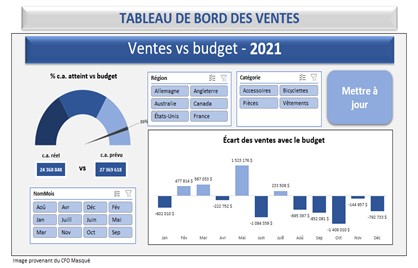
The information it contains comes directly from the accounting system. It is normally exported to Excel in order to build tables that will enable you to track the information you need to know (gross margin, sales, variance against budget, fixed costs, etc.). Data on sales, purchases, customers and suppliers can also be used to create tables that will make the analysis of financial and operational results quick and easy to understand.
With this tool, it’s even possible to track variances between actual results and the initial budget. Some accounting software packages allow you to configure the dashboard in-house, without exporting data. In such cases, excellent knowledge of the software is required to program the dashboard according to the desired information. Manufacturers also offer technical support, so don’t hesitate to make use of it.
To conclude
You’ll understand that the primary purpose of financial information and the dashboard is to help management make decisions.
Access to quality information at the right time, not just at the end of the year, is the key to success. That way, you have all the information you need to make informed decisions and ensure your company’s prosperity. The abstract “bank account” method is a thing of the past!
An article by Gustave Legault-Brousseau, CPA Director – Consulting Services